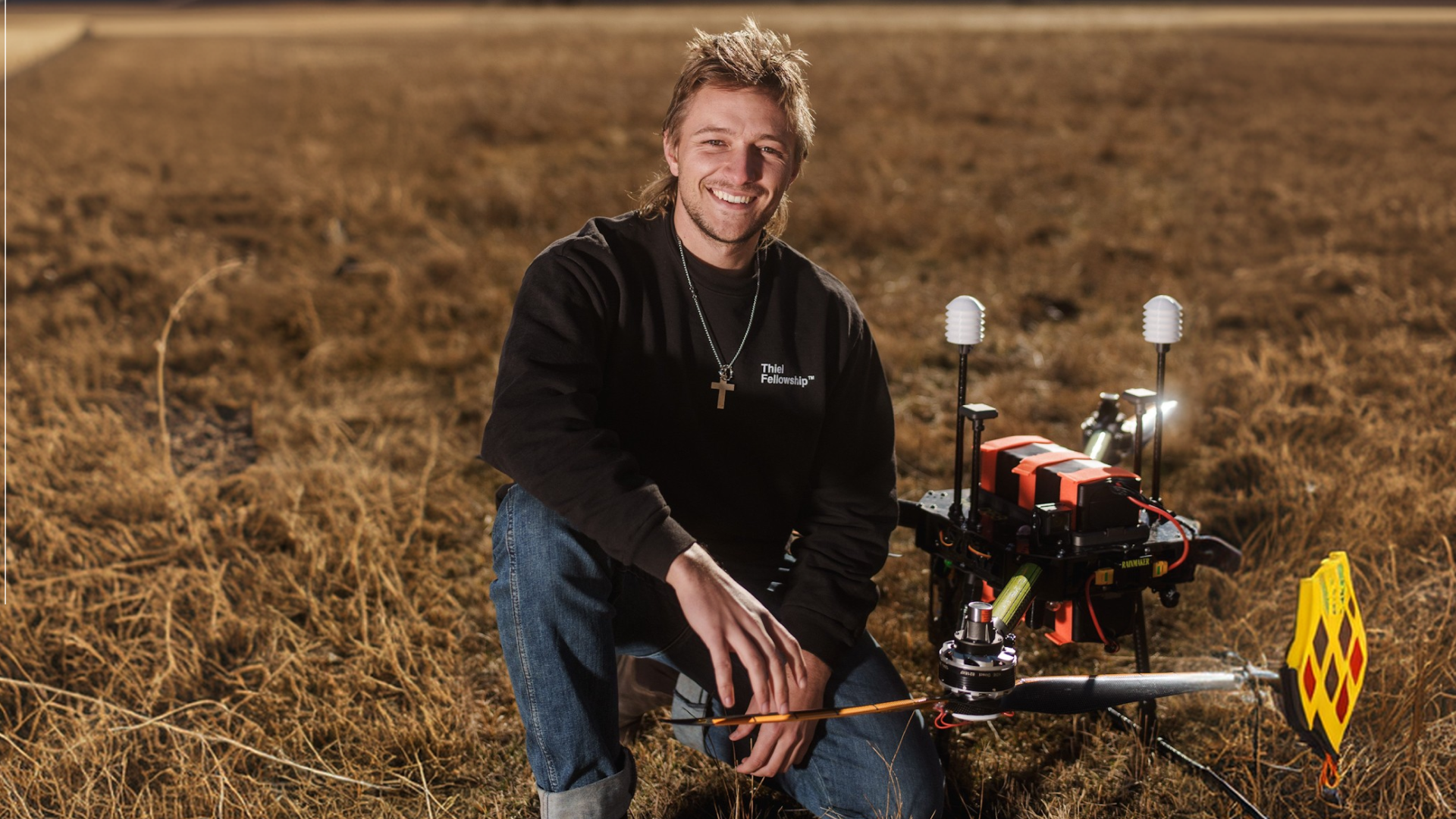
The first time I walked into Rainmaker's El Segundo facility, it was a Sunday. I expected an empty floor. Instead, most of the team was there: engineers bent over drone frames, meteorologists arguing over radar returns, someone on the phone with a field crew in the mountains.
That was the moment I realised this was a founder, and a team, that would stop at nothing to make this vision happen.
Today, we're proud to share that noa has co-led Rainmaker's $100m Series B, alongside Upfront Ventures, DCVC, Lowercarbon Capital, and Dream Ventures.
Why Rainmaker matters
Water is a fundamental layer of Humanity's OS. The world is running out of fresh water faster than it can build new supply. This year brought the lowest snowpack on record as well as the hottest and driest summer. Snowpack is the Western United States' largest reservoir: it is what fills the rivers every spring, so lake, dam, and river water levels were at record lows.
The Colorado River, which supplies around 40 million people, is the sharpest example. Across the basin, use exceeds natural flow by roughly 2.6 million acre-feet a year. Lake Mead and Lake Powell together hold 12.5 million acre-feet, less than a quarter of their capacity. The new federal framework cuts 1.25 million acre-feet a year from Arizona, California, and Nevada from 2027 - water that farms and cities have relied on for decades.
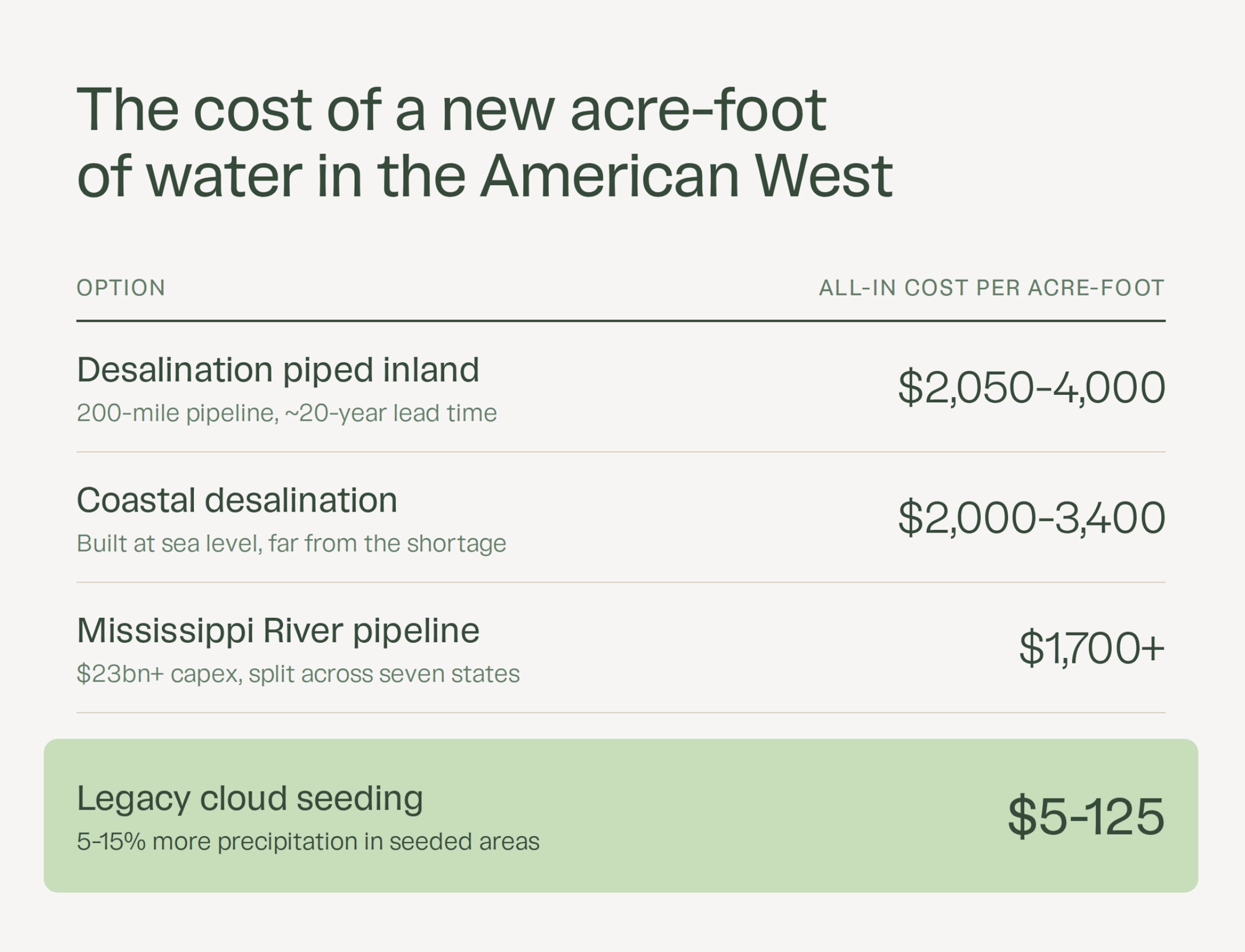
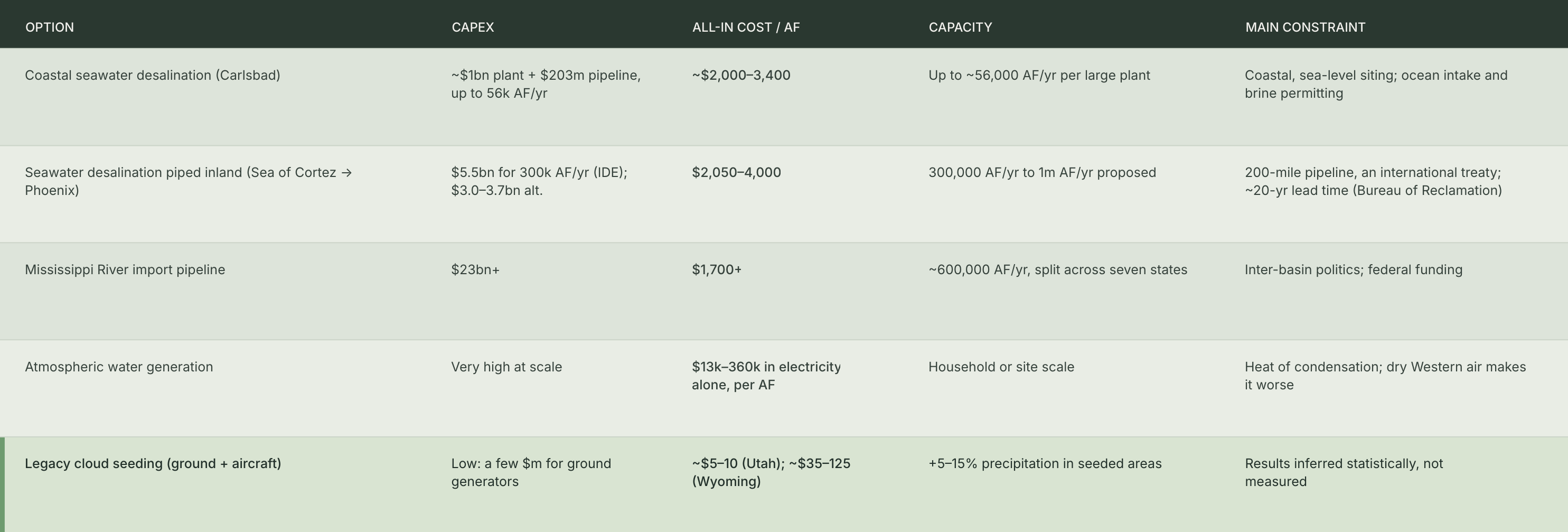
The alternatives are expensive and slow. Desalinated water from Carlsbad costs around $3,400 an acre-foot. Piping desalinated water from the Sea of Cortez to Phoenix would cost billions and, by the Bureau of Reclamation's estimate, take 20 years. Utah is already paying farmers around $390 an acre-foot simply not to irrigate.
When the cheapest option on the table is to stop growing food, you know that we have a real problem. The world needs water at a price farmers and cities can actually pay, and we need it within years, not decades.
What Rainmaker is building
Rainmaker's answer is to make more water fall where it is needed. Its drones fly into winter storms and release tiny particles, giving supercooled droplets something to freeze onto so they fall as snow on the mountains that feed the rivers. Its own radar then measures what each flight produced.
The near-term goal is to make that water dependable and verifiable enough that water districts, hydropower operators, and farmers can buy it by the acre-foot. The long-term ambition is far bigger: to turn the atmosphere, which at any moment holds several times more water than all the world's rivers combined, into a supply that dry regions can plan around. Ultimately, the goal is to have some command over the environment, allowing us to turn arid regions green, suppress hail, and redirect storms.
An ambition that size needs a particular kind of founder.
The man turning the dream into a reality
Anyone who has met Augustus will know that he is one of a kind. The mullet- and cowboy-boot-wearing founder exudes a passion and drive unmatched by anyone, and it pushes the entire company forward at a relentless pace. Before Rainmaker, he built groundwater software for Texas well operators and learned that you cannot pump what isn't there. So he went looking for the source, and found it overhead.
Early on, one of the first drones went down in a remote mountain area. Augustus and the team went in after it and ended up being chased by wild dogs while they tried to recover it. It is a fair example of the company's motto: we like the taste of blood in our mouths.
That passion runs through the entire company. Rainmaker's field technicians spend the winter high in the mountains, launching drones into storm clouds in the early hours of the morning, in snow and cold that would send most people home. And Rainmaker has no trouble finding people who want to do it. In a hardware company, that kind of pull is an advantage you cannot buy.
What they've built in three years
Cloud seeding is 80 years old. Its problem has never really been cost: Utah estimates its state programme produces water for $5 to $10 an acre-foot. Its problem has been proof. For decades, nobody could say with confidence how much water a seeding operation actually produced.
In three years, Augustus and the team have changed that. Rainmaker has made seeding measurable, automated flight, and improved yield, and along the way it has:
- recorded 82 unambiguous seeding signatures over four months, totalling more than 145 million verified gallons of water;
- grown operations across 12 states and three countries; and
- developed bio-organic seeding agents that are 10,000 times more effective than silver iodide.
That is an extraordinary pace of execution, in one of the least forgiving environments a startup can choose. It is exactly what you would expect from the founder and team described above.
Why the physics matters
Every other way of making new water pays for it in energy. Desalination has to force water through membranes and pump it uphill away from the coast. Pulling water out of the air has to remove the heat of condensation, litre by litre. The atmosphere has already done that work for free: the sun desalinated and lifted the water, and the atmosphere condensed it. Seeding simply tips it over the edge.
Location matters just as much. Seeded snow lands at the top of the watershed, which is exactly where it is needed. The mountains store it, and gravity delivers it. Desalination makes water on the coast, at sea level. We've written up the full comparison below for anyone who wants the numbers.
What we're holding ourselves to
Rainmaker is already the largest cloud seeding operator in the US. The goal now is to scale operations exponentially at home and internationally.
There is a long way to go. Today's verified volumes are still small against the Colorado River's gap. Closing it means more teams in the field, in more watersheds, every season.
Alongside that growth, Rainmaker will keep developing its measurement capabilities, so it can measure what each operation produces in the most productive conditions and in the most challenging ones. That is what this round funds.
At noa, we back founders taking on the hardest problems in the physical world. Water is the most physical of them all. We're grateful Augustus and his team let us join them.
Onwards and upwards.
The first-principles case for cloud seeding
Delivered where the world actually needs it, cloud seeding is one to two orders of magnitude cheaper than any other way of creating new water. Its limits are capacity, reliability, and proof, not cost. All figures are per acre-foot (AF): 1,233 m³, or about 325,851 gallons.
Three energy bills decide the price of water
New water has to be separated (from salt or air), condensed (from vapour to liquid), and lifted (to where people need it). Each alternative pays a different combination of these bills.
- Seawater desalination pays the separation bill. Reverse osmosis uses about 2.5-6 kWh/m³, or roughly 3,100-7,400 kWh per AF. At $0.08-0.10/kWh, that is $250-740 per AF in electricity. Energy is only about a third of the all-in cost.
- Atmospheric water generation pays the condensation bill. Turning vapour into liquid releases about 2,450 kJ/kg of latent heat, which the machine has to remove: roughly 0.68 kWh per litre, or about 840,000 kWh per AF, before any heat recovery. Field units measured 0.13-3.64 kWh per litre, and performed worst in the arid Southwest.
- Lifting costs about 2.7 kWh/m³ per 1,000 m of elevation in theory, and roughly 3.6 kWh/m³ once pump losses are included, before any pipe friction. That is about 4,500 kWh per AF for every 1,000 m or $450 in energy alone.
- Cloud seeding pays none of these bills. The sun has already evaporated and lifted the water. The cloud has already condensed it into supercooled droplets. Seeding adds a few grams of a seeding agent (traditionally silver iodide) so those droplets freeze and fall. The energy input is a drone flight.
How the options compare
The chart shows the headline cost of each option. The table below adds capex, capacity, and the main constraint for each.
Location: the shortage is inland and uphill
The world needs more water inland and uphill, where it can be distributed easily and used for farming. Colorado River basin use exceeds natural flow by about 2.6 million AF a year. The Lower Basin faces 1.25 million AF a year of cuts from 2027.
Desalination makes water at sea level, which is great for the people who live there but is not where it is needed most. Lifting it to the Great Salt Lake (about 1,280 m) roughly doubles desalination's energy bill, before the pipeline capex. Lifting it to the Colorado headwaters (2,500-3,500 m) would cost several times the energy of desalinating it. That is why nobody proposes it.
Even at sea level, the scale is daunting. Replacing just the Lower Basin cuts would take about 22 Carlsbad-sized plants, around $25bn of capex, all on the coast.
Seeded snow falls at the top of the watershed. The snowpack stores it until spring, and gravity delivers it to the reservoirs.
The conclusion
Cloud seeding and desalination are complements, not substitutes. Desalination is the reliable, expensive supply for coastal cities. Cloud seeding is the cheapest additional acre-foot at the top of an inland watershed. What matters for Rainmaker is how quickly its cost per verified acre-foot falls as teams are added, and whether verification extends from the cloud to the river.
Sources
- Rainmaker: Announcing the $100M Series B
- Fast Company on the Series B
- National Geographic: Can this army of drones solve the West's water crisis?
- Lowercarbon: Abundance from Above
- Runtime Wire on founder background
- Maven's Notebook: desalination in California
- California Policy Center: Carlsbad financing
- Choices Magazine: Arizona augmentation costs
- Arizona Capitol Times: WIFA desalination estimates
- KAWC: Arizona desalination proposals
- AZ Water Agenda: Mississippi pipeline
- Hannah Ritchie: desalination energy
- IOP: energy intensity of atmospheric water generators
- Utah State University Extension: cloud seeding costs
- Wyoming legislative briefing on cloud seeding costs
- DU Water Law Review: state bans and cost comparison
- CSG West: Colorado River forum, September 2026
- reservoirs.earth: Mead and Powell storage
- E&E News: Heat, drought and wildfire shatter records in the West
- PR Newswire: Rainmaker raises $100M Series B
